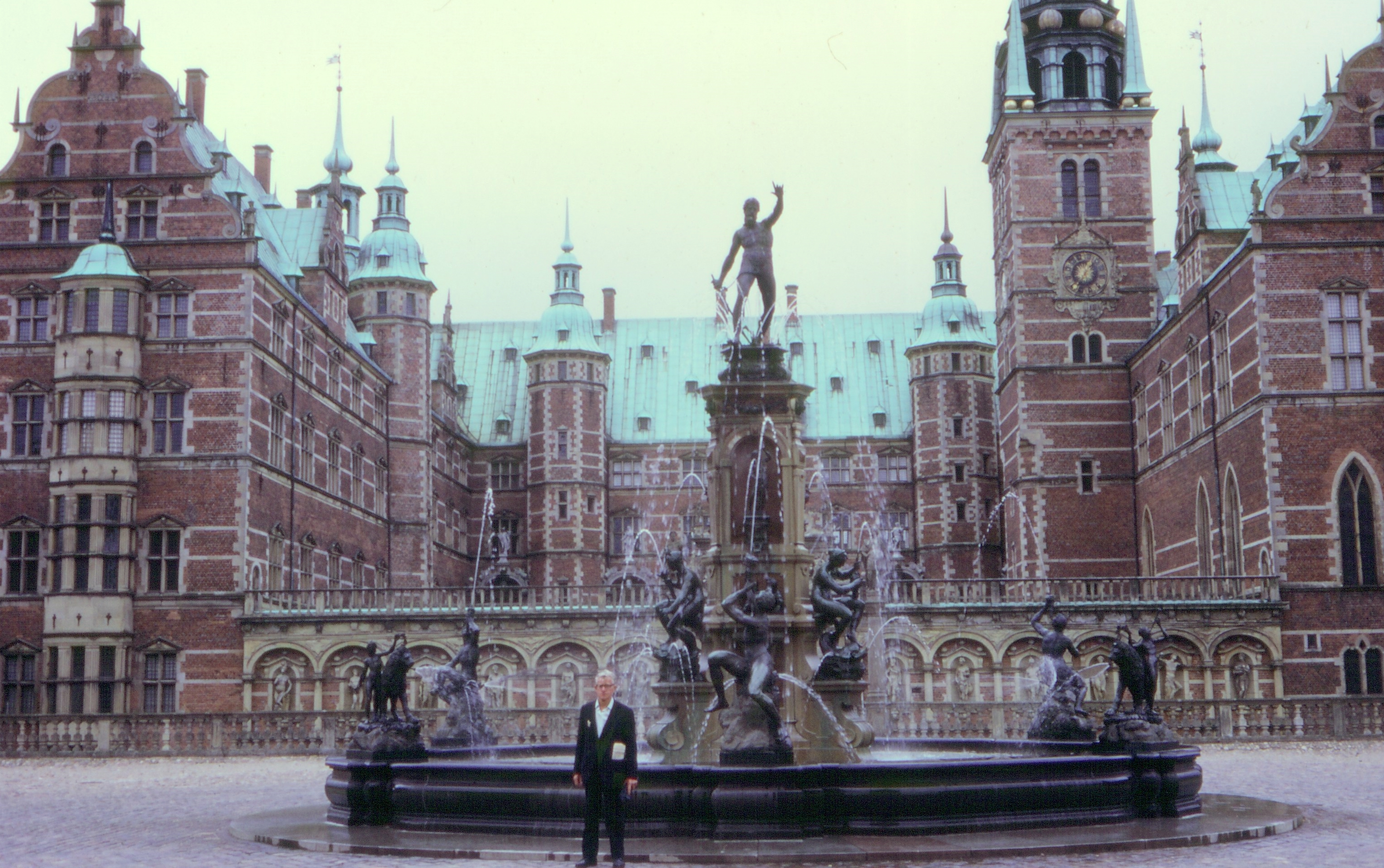
John Hald was the son of Johanne Marie Larsen and Anton Hald. He visited South
Dakota at least once and wrote some observations about his trip. He lived in
Copenhagen and was visited there by American relatives.
Among Descendents of People From Thy in South Dakota
From 'Jul I Thy' (Christmas in Thy) by Johs. Hald, Copenhagen, 1963
I recently visited USA, and had a lot of good experiences. My headquarter was S. Dakota.
From there I went east to Minnesota and west to the Black Hills near the border of Wyoming,
where a man from Vendsyssel, Denmark, had made huge statutes in the mountainside of the
presidents Washington, Jefferson, Lincoln and Roosevelt. I rode through Nebraska, Missouri,
Kansas, Oklahoma and Texas down to the Gulf of Mexico. I went briefly over the border and
saw somewhat of Chicago and New York.
Much can be said of what you see, when you get around in God's Own Country, but I was not
made an expert. I would rather tell about the relatively small part of the states, that I got to
know, about Kingsbury County in sunny South Dakota. I lived in the small city of Arlington,
about the size of Snedsted (a village in Thy, Denmark). Six to ten miles from here is a lake with
the homely name of Lake Thisted.
The history of the white man in these parts is not long. It started in 1872 when two young men
from Thy, Andreas Jensen from Bedsted, and Lars Kristensen from Snedsted arrived here from
the copper mines of Upper Michigan, where they had worked. They took homestead according
to the law of 1862. Their place was about eight miles from Sioux Falls, now the biggest city in
South Dakota, about 53,000 inhabitants, and 80 miles from the nearest railway station, Sioux
City in Iowa. They built a hut into the earth, 6 feet deep and covered with turf from grass.
They broke up the earth and grew wheat in a great area.
They left after 4 years because grasshoppers ate the wheat. With 2 oxen to pull their prairie
wagon they went north to find something better. After 70 miles they camped at Lake Thisted.
They liked the area and thought about staying, but swarms of birds made a constant noise so
they could not sleep for their 2 days there. They went on over the rough prairie.
Not far away they found a nice place at Lake Albert, named after Lars Kristensen's eldest son,
the first white child to be born in Kingsbury County. Here they took preemptions land.
Homestead could only be taken once. They built 2 houses into a hillside, and started to
cultivate the land. When they lived at Sioux Falls their fiancès had arrived, and they married.
Andreas' wife Anna Margrete Olsen was born in Hvidbjerg, Thyholm, and Lars wife, Maren
Pedersen, came from Tingstrup just outside Thisted. A couple of years later Lars' 2 brothers,
Peter and Mathias and their wives arrived after some years in Upper Michigan. They took land
nearby. Quite a few children arrived so the area became a colony of people from Thy. Others
arrived and the area became what is now known as Kingsbury County. Later on Peter opened a
store. He wrote about the first pioneers on the Dakota Prairie. My information is from him
and other old people there.
It was a hard and primitive life to be a settler. It demanded strong health and will, and a firm
belief in that you could make a future there. No machines or remedies. Everything is wild and
desolate. No white people within many miles, only thousands of wild buffaloes and savage
Indians, who at any time could attack the settlers, but after all it was their land that the white
man occupied. The weather changed a lot, and hailstorms could spoil years of work. Winter
could bury them in lots of snow. They had to dig tunnels to get out to the cattle. Thaw could
drown the animals. The winter 1880-1881 was hard and tough. The first snow came October
15th, and the hard winter last until April 16th. An awful thaw then came. They sailed in boats
over the fields and many people and animals lost their lives. In the summer they fought bugs
and fires threatened to destroy both houses and crop. Distances were huge and there were no
roads or railways. Their only means of transport was the prairie wagons drawn by oxen. A trip
to the city to get provisions took several days. The journey was taken in the autumn, because it
was impossible in the winter. When they turned homewards they had a big load of provisions
for a whole year. Often money was scarce so they had to stretch the food in their cold earth
caves. Solid fuel was grass and dried cow manure. Matches were expensive, if you run out, you
had to walk several miles to borrow some.
It was a hard time for the young people from Thy; but they came through. Dawn came with
better times and conditions. More people arrived, from Thy, Mors, and elsewhere. The colony
grew. Poverty was replaced by prosperity. The earth caves disappeared and were replaced by
nice buildings. They could afford to buy machines and they got horses and spring carts. Wheat
and corn was grown on the former prairie. Trees grew up and gave shelter around the farms.
The coming of the railway around the turn of the century was a great progress. A lot of time
was saved. In the years up to the first world war the tie of the pioneers was about to end, and
the Dakota prairie had changed to become a decent part of the States. And the first pioneers
began to die. Andreas Jensen's wife, An Margret, died so early as 1881, 33 years old, and left
Andreas with 4 little children. A tragedy in a farmer family at that time, and it was difficult to
get a woman into the house again. To be a farmer's wife was quite a job. Lars Kristensen, the
grand old man of the colony, died in January, 1913. He had become a wealthy and esteemed
man in the area. He was 71. He was buried by a lot of mourners, 85 carts and 7 cars.
Coming to Kingsbury today it is hard to believe that this was only bush land not so long ago.
Now every place has been cultivated, and towns have been raised. And now it is easier to get to
and fro. When An Margret from Hvidbjerg in 1873 at last reached Andreas in Sioux Falls, she
had been on her way from New York in a slow train for 4 days, and the last many miles in a
hard wagon. The journey was not just fun. Today a jet takes you to Sioux Falls in a couple of
hours, and from there you ride the 80 - 90 miles to Arlington in a car. Up in the air you cannot
help to think of your old country folks who went along down below in uncomfortable wagons
for days. They worked hard and founded the later wealth. Now they rest in their graves in the
small cemeteries.
One of the last one from the old time, Jens Larsen from Snedsted, died about 1955, 94 years
old. When you stand at this old pioneer's grave, you bow your head in respect of what this old
country fellow did in the creation of the new USA. These hard working men were true heroes,
as great if not greater than the ones who now try to conquer the moon.
Kingsbury County today is no longer a definite colony of people from Thy. People have come
from the other parts of Denmark and from the other Scandinavian countries, but from
Germany, Ireland, Scotland, Switzerland, Holland, and other places. Ten miles west of
Arlington is a town called Volga, the Russians lived here, but they moved up to North Dakota,
not on account of the - then not invented - cold war between East and West, but because the
climate further north suited them better. The name of the town and some street names
reminds us about the Russians, but now mainly people from Norway and Holland live here.
You can easily count the people here who were born in Thy, but you meet their descendants. If
you get into conversation with people in the street, and they hear you are from Denmark, you
can in 5 of 10 cases be sure, that their parents or grandparents were Danes. If you ask where
they came from, you hear names such as Thisted, Snedsted, Hundborg, Østerild, Sønderhaa,
Vesløs, Glæde, Frøstrup, and other names from the homeland. But if you address them in
Danish, most of them shake their heads, saying not understand. In some cases it helps you if
you use the dialect from Thy. Some of them will then understand. This dialect was spoken in
their homes many years ago, and a bit of it is still alive. Many from the younger generation is
more or less mixed up with people from other nations, but many are aware that they are of
Scandinavian origin. I met several 'genuine' Scandinavians - one thirds from Thy, one third
Norwegian, and one third Swedish. This to me stands as Scandinavian cooperation.
I met some second generation people from Thy, who could understand and speak the Thy
dialect at a reasonable level. One of them said to me that I had perhaps lived too long in
Copenhagen. He did not find my mother tongue correct. It was an experience to converse with
a native American who spoke the language that was spoken in Thy 80 - 90 years ago. But our
language there is disappearing, and will soon be forgotten. They get very few Danish
emigrants, and they are prepared to speak English. The young ones are proud of their roots,
but feel they are not 100% American peoples.
Although the descendants from the Thy people are only part of the population in Kingsbury
County, it is my impression that they have set the standard of the population as a whole. I
cannot say exactly how, but I feel it lies in the air, that the spirit from Thy leads, and that the
temper from Thy is in the people. You feel on homely ground when you walk among them.
Over here they have preserved the old custom, that when a wife lies in her childbed, the
neighbors bring her childbed food, a plate of soup or stewed fruit (prunes). This was a
common custom in Denmark, in Thy, too. It is hardly known in Denmark any longer, but it is
still alive over here in the States. Other things reminded me of old times in Thy. In my time as
a boy I remember that Saturday night was something of a festival. Country people came to
town to shop - the shops were open until very late - but also to take a promenade in the streets
and to be together with friends and acquaintances. You could see people standing, talking
together on the pavements or in the streets - there were very few cars to run over people then.
They also went to the pubs and had a few drinks or more.
Saturday night in Arlington is also somewhat of a festival. People meet in the Main Street.
Shops are open till late. But they do not arrive on foot or on a bicycle like in Thisted - people
would laugh at them, and consider them to be mad, if they did. They arrive in cars, even people
who live only a hundred feet from Main Street. They park along the pavement in both sides.
Most of them want to buy something, but when that has been done, they enter their cars again
and look at life in the street. If they spot friends they shout at them, and they come into the car
if there is room. Otherwise they stand outside and chat through the open windows. Around
nine o'clock something happens. A fire engine stops in front of the town hall with light and
loudspeakers. The shops have given out free lottery tickets all day, and now the winner is
announced. He or she gets 25 dollars. People go home then.
I got the impression that only a few went to a restaurant; most of them went to bed in order to
rise early Sunday morning to go to one of the four churches. The town had 4 pubs, and they did
not lack customers, but in my time in Arlington I did not notice one drunken person.
People here are very social and interested in other people. They have a paper, The Arlington
Sun, the window mirror of the town and the area. Mainly local news, not just births,
engagements, weddings and broken legs but also very common things like people visiting each
other to drink a cup of coffee together. When I had arrived, I was an interesting item. It was
announced that I had come by air from Copenhagen to see relatives and friends, and the paper
followed me from day to day, where I had lunch and dinner, afternoon and evening coffee, etc.
They informed if I went away, and when I returned, I was welcomed in the paper. You could
not hide. The editor of the news column, Mrs. Maria Krahn, is a daughter of the old Jens
Larsen from Snedsted.
I was invited to some picnics. You live rather primitively and make your meals out in the open
in the parks where you find fireplaces which charcoal or wood. Two of the picnics were family
gatherings, arranged on account of my visit. One time the descendants of Jens Larsen from
Snedsted had been called together, and the other time it was the descendants of Jens Larsen's
sister, Stine, married Wonsbek, who came to Dakota about 85 years ago, and who died in 1915.
Both the old and the young people took part, 3 - 4 generations. I was invited as a kind of guest
of honour, I only belong to a side branch of the family. There is a happy spirit at such
gatherings, and a lot to discuss when relatives from different places meet. They eat well and
play games, among them one with a huge and heavy horse shoe made for this purpose. And
this is the only time when a horse shoe is used - horses are relics from the past, hardly known
here now. I saw only one single horse up in the deserted area at the border to North Dakota. A
man rode around on an old horse to manage a big herd of turkeys.
Not many things in the US impresses you much. They are not a lot further ahead of us with
technic and other things - everything is just in a bigger scale. What I liked about the people on
the prairie was they were so wonderfully unpretentious and unsnobbish They were very
straight with one and another, and strangers were welcomed heartily and without formalities. I
experienced this on a tour to the Black Hills. I passed through the main and residential town
Pierre, a pretty little town with 5,000 - 6,000 inhabitants and went in to see the government
building. A lady asked me to write my name in a visitor's book, and when she noticed that I
came from Denmark, she got engaged. Well, I was a Dane, so I was a Scandinavian, too. So
was the governor, he was of Norwegian origin, and she was sure, he would like to meet me. I
doubted it, and thought she made a joke. But the girl ran into another office, and came back
immediately. The Governor, Mr. Gubberud, would like to see me. He understood Norwegian,
and could tell me all that I wanted to know. The Governor received me with his sleeves rolled
up, behind a huge desk full of this morning's mail. He was a tall, strong man - previously he
had been a farmer - and it was a huge fist he stretched out against me. His knowledge of
Norwegian was very limited, so we spoke American. He was extremely kind but I understood
that his time was scarce, so our conversation did not last long. In the next issue of The
Arlington Sun, readers were told that Mr. Hald from Copenhagen had shaken hands with the
Governor himself. I wondered if things were as informal as this in the White House or at the
King's audiences in Copenhagen.
South Dakota is called Sunshine Country, land of the beautiful sundowns, and the sun - both
that of Our Lord and The Arlington Sun - shone on me almost every day during my stay. For a
few days I lived along the banks of Lake Poinsett. It was wonderful in the mornings to see the
sun rise, spreading its rays on the blue water of the lake. But the best time was at evening time
when the great prairie lay as a wavy ocean that had settled, with the sun standing red as a
flaming bonfire, slowly dying out. When the sun went down far out, its rays flowed like
streams of gold out over the green prairie. If you have once seen this sight, you have forever
lost your heart to South Dakota.
Johs Hald (1963)
